Thanks to Johnny Xod and Django Edwards for bringing this to my attention.
Showing posts with label video. Show all posts
Showing posts with label video. Show all posts
Wednesday, December 16, 2009

Monday, October 26, 2009
Dick Van Dyke on Slapstick
Thanks to Drew Richardson, Dramatic Fool for pointing this out -- a hilarious mini-lecture about how slapstick is no longer funny, and then Mr. D.V.D. proceeds to schlap the shtick all over it.
This is an object lesson in how to build a physical routine where the audience know what's coming, but they can't help themselves from laughing anyway.
This is an object lesson in how to build a physical routine where the audience know what's coming, but they can't help themselves from laughing anyway.
Monday, September 07, 2009
All of Seinfeld for $100!
Every once in a while Amazon comes out with a deal that is too good to resist, this is such a deal.
NOTE: This is now $140! It's still a pretty good deal, but obviously $100 is better!
Every episode of Seinfeld for $100 . While it's not clowning per se, there are great archetypes at work here, and the physical work of Michael Richards and his myriad jitters, sputters, spewers, and oh yes, can we mention his door entrances?
This is one of the funniest television shows ever, and you have the opportunity to own it all for less than $100. What are you waiting for?
NOTE: This is now $140! It's still a pretty good deal, but obviously $100 is better!
Every episode of Seinfeld for $100 . While it's not clowning per se, there are great archetypes at work here, and the physical work of Michael Richards and his myriad jitters, sputters, spewers, and oh yes, can we mention his door entrances?
This is one of the funniest television shows ever, and you have the opportunity to own it all for less than $100. What are you waiting for?
Monday, July 06, 2009
Clowns in Style: NY Times article about two clown's homes
Two Dell'arte Graduates get their house (and their work and their website) featured in the NY Times!
http://www.nytimes.com/2009/07/05/realestate/05habi.html
Habitats


http://www.nytimes.com/2009/07/05/realestate/05habi.html
The Traveling Circus Stops Here
Ruby Washington/The New York Times
Christina Gelsone and Seth Bloom, both clowns, rehearse in their apartment
CHRISTINA GELSONE, a slender 36-year-old with delicate features and hair the color of a ripe eggplant, lay flat on her back on the bare parquet floor of her West Harlem apartment, an expectant look on her face.
Photographs by Ruby Washington/The New York Times
Christina Gelsone and Seth Bloom made three small rooms into one large space. “When Seth chose red kitchen cabinets,” Ms. Gelsone says, “I thought to myself: ‘Yes! I married the right guy.’ ”
Her husband, Seth Bloom, 34, whose dark hair shimmers with electric blue highlights, placed his palms atop hers. Then he balanced over her, almost as if he were floating in the air. The couple held the pose silently, the only sound on this quiet weekday afternoon the bird song outside their kitchen window, which offers a view of leafy St. Nicholas Park.
Ms. Gelsone and Mr. Bloom are professional clowns, and they regularly perform feats like these in their fifth-floor walk-up on St. Nicholas Terrace, a turn-of-the-century apartment house near 128th Street that in 1996 was converted into a co-op for families earning low to moderate incomes.
The onetime railroad flat, where the couple has lived since May 2008, is also their rehearsal space and office. A small room off the narrow hallway, for example, is crammed with tools of their trade like stilts, water bombs, juggling pins, soap-bubble solution and oversize balloons — not the items stashed in your average New York linen closet.
But Ms. Gelsone and Mr. Bloom, known professionally as the Acrobuffos (for a glimpse of what they look like in action, check out their Web site, www.acrobuffos.com), are hardly your average clowns.
They perform their acrobatics, mime, juggling and theatrics (but no fire-eating, Ms. Gelsone says, because it destroys your teeth) in some of the most troubled places on earth. They make annual visits to Afghanistan, where they met in the summer of 2003 (yes, they know it sounds like the start of a joke: “Two clowns meet in Afghanistan ...”). Individually or together they have also performed in Kosovo and Serbia in the Balkans, where memories of past conflicts are still vivid.
“We’re sometimes the only Americans without guns that people have seen in these places,” Ms. Gelsone said that afternoon after scrambling up from the floor and settling herself next to her husband beside a low stained-wood coffee table bought for $350 at My Little India, a store in Brooklyn that sells Indian imports, and one of the priciest items in the apartment.
“You’re just a little clown going over there. But what we do is offer people a chance to release their emotions, which is the first step to recovery.
“Sure, you can build a hospital and get a plaque with your name on it,” she said.
And Mr. Bloom added: “Hospitals and infrastructure are part of what’s needed. But people need to be people. What we do lets kids dream. What we do lets them imagine a future.”
The two were a professional couple for several years before becoming a romantic one, in part, as Ms. Gelsone explained, “because it’s a cardinal rule — never date a clown partner.”
“You can find a date anywhere,” she said. “But a clown partner? Not so easy.”
By spring 2007, however, they were living together in an apartment opposite their current building. By that Christmas, after a pageantlike wedding in the Chinese city Hangzhou, for which Ms. Gelsone wore a dress made of white balloons, and a honeymoon in the Wakhan Corridor of Afghanistan, one of the most remote parts of the world, they had found their home on St. Nicholas Terrace.
Their apartment house is more than a century old, but was rejuvenated by a city program that established it as a Housing Development Fund Corporation. Under this program, buildings owned by the city are renovated and the apartments made available to families whose annual earnings fall under a prescribed level.
The goal is to help families of relatively limited means become homeowners, and the impact in minority neighborhoods like this one has been considerable.
The program’s ideological underpinnings appealed to the couple (Mr. Bloom ended up as vice president of the co-op board). And to a couple that earns $50,000 to $70,000 a year — clowning isn’t the most lucrative of professions — the deal was attractive financially.
They bought their six-room apartment in May 2008 for $262,000; their monthly maintenance is $615. They set about transforming it into a space that would accommodate their not-so-traditional lifestyle. To create an area in which to rehearse, they collapsed the three small front rooms into one spacious area and redid the floors, each of which had been built at a slightly different level, to make one continuous expanse; renovations came in at just under $20,000. They furnished the room with items from Ikea (cheap) and tatami mats (easily stacked and stashed). During the day, when most of their neighbors are out, they can do handstands and pratfalls to their hearts’ content.
As a gentle homage to their time in China, they painted the kitchen in red, gold and blue, the colors of the Forbidden City in Beijing.
“When Seth chose red kitchen cabinets,” Ms. Gelsone said, “I thought to myself: ‘Yes! I married the right guy.’ ”
They find the ungentrified nature of their neighborhood appealing. People barbecue in the back of their buildings, play music on the street, and are so chatty, it can take 15 minutes to collect the mail.
“Where we travel, life happens on the street,” Mr. Bloom explained. “This is more like the rest of our lives.”
While their professional center of gravity lies thousands of miles away, the apartment is alive with images and paraphernalia that evoke their life on the road. These include not only the clowning tools in the closet and the grinning papier-mâché masks that Mr. Bloom has created using a plaster mold of his head, but also his vibrant color photographs, displayed on the living room walls, which provide a vivid record of the couple’s travels.
The scenes from Afghanistan are especially compelling.
There are pictures of boys with a jug, selling glasses of water for one afghani (two cents) apiece. There is an image of boys playing soccer in front of the old palace in Kabul and another of a traditional Central Asian sport called buzkashi that is played on horseback and involves tossing around a dead goat.
One of the most joyous images shows a girl from a Kabul orphanage standing on a pair of borrowed stilts and looking exultant.
“She was up there for four or five hours,” Mr. Bloom said. “She said she never wanted to come down.”
Thursday, May 07, 2009
Cruel & Unusual Comedy at MOMA (NY) May 20-June 1, 2009
Cruel and Unusual Comedy: Social Commentary in the American Slapstick Film
May 20, 2009–June 1, 2009
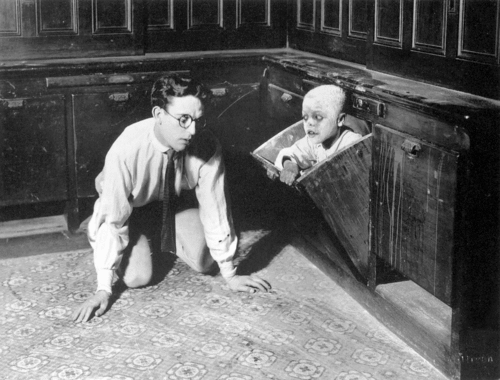
You can read film notes written by Steve Masa and Ben Model on their specialty blog http://cruelandunusualcomedy.blogspot.com/
You can find out more about the series on the MOMA website
http://www.moma.org/visit/calendar/films/948
Tickets are $10, less for seniors and students, and free if you are a MOMA member (although you do still require a ticket.
Drag Shows: Cross-Dressing the Sexes
Wednesday, May 20, 2009, 4:00 p.m.
With piano accompaniment by Ben Model
- Getting Rid of Trouble 1912. USA. Directed by Del Henderson. With Charlie Murray. 10 min.
- Sweedie Learns to Swim 1914. USA. Directed by Wallace Beery. With Beery. 10 min.
- Chasing the Chaser 1925. USA. Directed by Stan Laurel. With James Finlayson. 10 min.
- Get ‘Em Young 1926. USA. Directed by Fred Guiol. With Stan Laurel. 18 min.
- Good Night Nurse 1917. USA. Directed by Roscoe Arbuckle. With Arbuckle, Buster Keaton. 18 min.
Race Riots: Beyond Black and White
Wednesday, May 27, 2009, 4:00 p.m
With piano accompaniment by Ben Model
- A Change of Complexion 1914. USA. Directed by Phillips Smalley. With Henry Bergman. 10 min.
- Haunted Spooks 1920. USA. Directed by Hal Roach. With Harold Lloyd, Sunshine Sammy. 20 min.
- Below Zero 1925. USA. Directed by Norman Taurog. With Lige Conley, Spencer Bell. 18 min.
- A Natural Born Gambler 1916. USA. Director unknown. With Bert Williams. 20 min.
- Black and White 1913. USA. Directed by Del Henderson. With David Morris. 10 min.
Gratuitous Violence: No Turn Unstoned
Wednesday, May 27, 2009, 7:00 p.m.
With piano accompaniment by Ben Model
- Deep Sea Panic 1924. USA. Directed by Roy Del Ruth. With James Parrott. 12 min.
- Their First Execution 1913. USA. Directed by Mack Sennett. With Ford Sterling. 10 min.
- The Phoney Cannibal 1915. USA. Directed by Charles E. Ward. With Lloyd Hamilton, Bud Duncan. 10 min.
- The Counter Jumper 1922. USA. Directed by Larry Semon. With Semon, Oliver Hardy. 18 min.
- Cold Hearts and Hot Flames 1916. USA. Directed by John G. Blystone. With Billie Ritchie. 20 min
Animals and Children: No Harm Done
Friday, May 29, 2009, 4:00 p.m
With piano accompaniment by Ben Model
- An Elephant on His Hands 1912. USA. Directed by Frederick Thomson. With George Ober. 10 min.
- Cat, Dog, and Co. 1929. USA. Directed by Anthony Mack. With the Our Gang kids. 18 min.
- Mind the Baby 1924. USA. Directed by Al Herman. With Pal the dog. 18 min.
- The Knockout 1923. USA. Directed by Len Powers. With the Dippy-Doo-Dads. 10 min.
- When Summer Comes 1922. USA. Directed by Roy Del Ruth. With Billy Bevan. 18 min.
The Machine Age: Mack Sennett vs. Henry Ford
Monday, June 1, 2009, 4:00 p.m.
With piano accompaniment by Ben Model
- Lizzies of the Field 1924. USA. Directed by Del Lord. With Billy Bevan. 18 min.
- His Bread and Butter 1916. USA. Directed by Edward Cline, Hank Mann. With Mann, Slim Summerville. 18 min.
- Get Out and Get Under 1920. USA. Directed by Hal Roach. With Harold Lloyd. 18 min.
- Squeaks and Squawks 1920. USA. Directed by Noel M. Smith. With Jimmy Aubrey, Oliver Hardy. 18 min.
- Neck and Neck 1924. USA. Directed by Fred Hibbard. With Lige Conley. 18 min.
Monday, April 20, 2009
Tim Conway on the Carol Burnett Show
One of the great television clowns that you don't hear much about anymore, but was a genius at physical comedy, esp. with obstacles.
I was alerted to George Fuller and Adrian Danzig, and nearly died laughing when I saw it.
(as did Harvey Korman, Conway's often broken up partner)
Conway is so matter of fact, but explores the limitations of his obstacle so brilliantly that whatever he does you both don't expect, and at the same time could completely see it coming.
Well worth watching
I was alerted to George Fuller and Adrian Danzig, and nearly died laughing when I saw it.
(as did Harvey Korman, Conway's often broken up partner)
Conway is so matter of fact, but explores the limitations of his obstacle so brilliantly that whatever he does you both don't expect, and at the same time could completely see it coming.
Well worth watching
Subscribe to:
Posts (Atom)
